
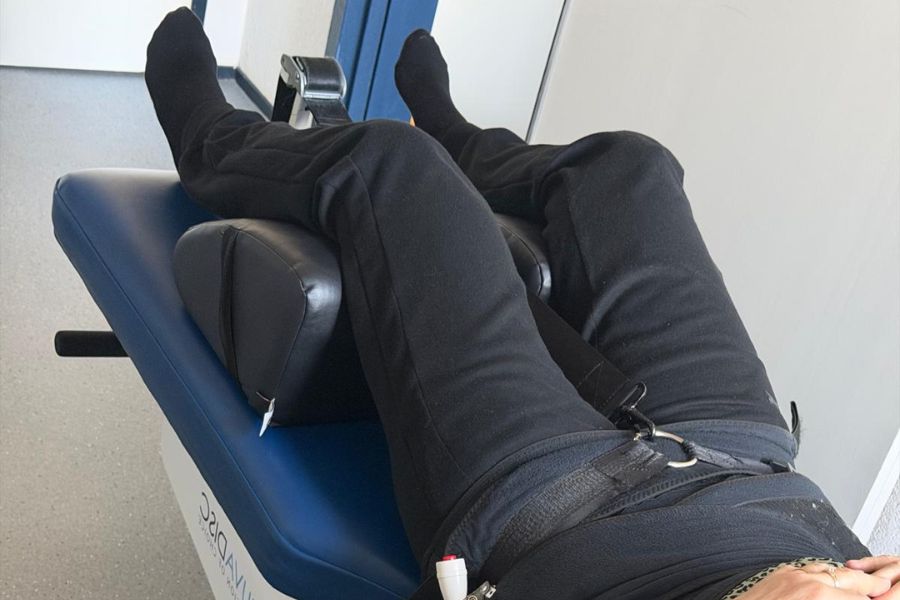
How does decompression therapy work for back pain and a herniated disc?
Decompression therapy is often used for back pain, herniated discs, and radiating pain. But how exactly does this treatment work?
To understand that properly, it’s important to look at how the spine and nerves function—not only in terms of space, but also blood flow and fluid exchange.
The spine is not a stack of bones
The spine is a dynamic system in which movement and fluid play an important role.
- Intervertebral discs work like sponges
- Nerves need oxygen and nutrients
- Small blood vessels provide blood flow
- Fluid flow helps remove waste products
When you move, pressure differences are created. These ensure that:
- Nutrients are supplied
- Waste products are removed
- Nerves can function properly
Why symptoms arise
Symptoms often arise when there is less space and less movement in the spine.
For example due to:
- A herniated disc
- Degeneration of the intervertebral disc
- A narrowing (stenosis)
- Joints that don’t move as well
This can cause:
- Nerves to come under pressure
- Blood flow to decrease
- The “supply” of nutrients to be disrupted
Nerves need “fuel”
Nerves are not simple cables. They are living tissue that depends on:
- Oxygen
- Nutrients
- Fluid exchange
When that supply is disrupted, symptoms can develop such as:
- Pain (stabbing or burning)
- Tingling
- Numbness
- Loss of strength
You can compare it to a garden hose with a kink in it: some water still gets through, but not optimally.
Soft vs. hard narrowing
Soft narrowing
For example, caused by:
- A herniated disc
- A bulging disc
- Swelling or irritation
This type of narrowing often responds better to treatment
Hard narrowing
For example, caused by:
- Bone formation
- Advanced wear and tear
- Structural changes
Options are more limited here, but symptoms can still improve
How decompression therapy works
Decompression therapy uses a controlled traction force on the spine.
This leads to the following:
1. More space
- Pressure on the intervertebral disc decreases
- Nerves have more room
2. Better blood flow
- Circulation around the nerve improves
- Irritation can decrease
3. Improved fluid exchange
- Intervertebral discs absorb fluid better
- Waste products are removed more effectively
This helps the body function better again and recover.
When does decompression therapy work well?
The treatment is often effective for:
- A herniated disc with radiating pain
- Nerve irritation
- Early to moderate wear and tear
- “Soft” narrowing
When is the effect more limited?
Decompression therapy may be less effective for:
- Severe bony narrowing
- Advanced wear and tear
- Permanent nerve damage
Decompression therapy vs surgery
Decompression therapy:
- Works without surgery
- Focuses on pressure and circulation
- Supports the body’s recovery
Surgery:
- Removes or alters structures
- Is usually only considered when other treatments don’t help enough
Not every back complaint is the same. That’s why we always first look at the cause of your symptoms.
During an intake appointment, we assess whether decompression therapy is appropriate in your situation and clearly explain what you can expect.
Feel free to get in touch or book an appointment right away.