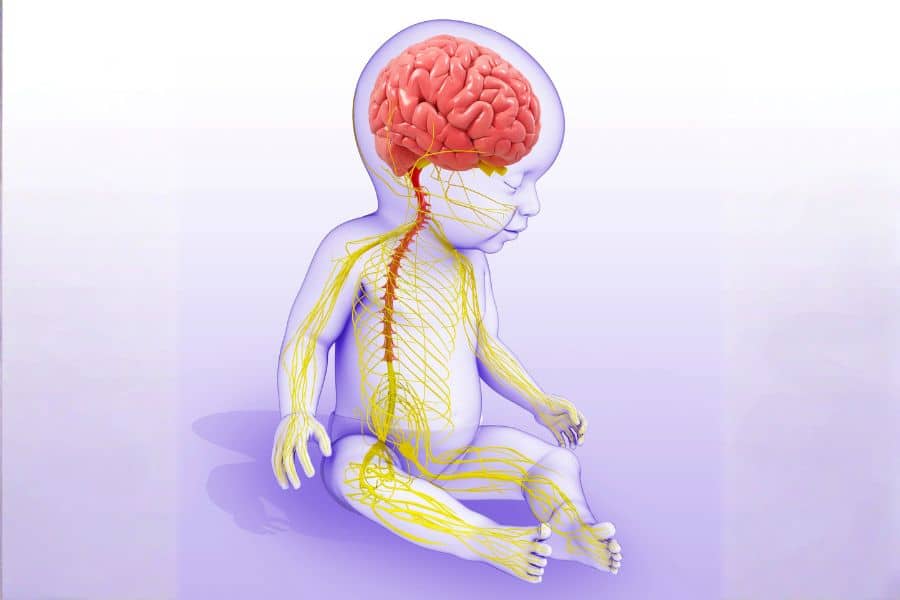
As a parent, you mainly pay attention to what you can see: how your child moves, talks, plays, and responds. What you can’t see, but what controls everything, is the nervous system. And that’s exactly where many misunderstandings exist.
The development of the nervous system doesn’t automatically happen in a “linear” way and is more closely linked to movement, stimuli, and physical experiences than many parents think.
The nervous system is not yet ‘finished’ at birth
At birth, the nervous system is functional, but still far from fully developed. The brain, nerves, and reflex systems mature mainly in the first years of life.
This development happens through:
- movement
- feeling
- experiencing balance
- repetition
- interaction with the environment
A child first learns to use their body, and only then to control it.
Movement is the foundation of neurological development
What many parents don’t know:
movement is not a result of development, but a prerequisite for it
Rolling, crawling, sitting, standing, and walking:
- stimulate connections in the brain
- help the left and right sides work together
- contribute to balance, coordination, and body awareness
When movements are skipped, limited, or develop asymmetrically, this can affect how the nervous system processes information.
The nervous system learns through stimuli—but not without limits
Stimuli are necessary for learning, but:
- too little stimulation slows development
- too much stimulation can overload the system
Some children seem:
- to become overstimulated more quickly
- more sensitive to sound, light, or busy environments
- to find it harder to calm down
That doesn’t automatically mean “something is wrong,” but often that the nervous system is still searching for balance.
Left and right need to learn to work together
The body is built symmetrically, but cooperation between left and right has to be learned.
If that cooperation doesn’t go optimally, you can sometimes see it in:
- a preferred posture
- moving more on one side
- clumsiness
- difficulty with coordination
- getting tired more quickly
These are signs of maturation, not immediately a problem — but they do say something about how the nervous system is functioning.
Not every signal is a ‘phase’
Some things are part of development; others keep coming back.
What often surprises parents:
- that complaints can disappear, while the cause is still present
- that behaviour sometimes has a physical component
- that rest isn’t always enough for recovery
The nervous system mainly learns through targeted, repeated input.
Development happens in spurts, not in a straight line
Children develop:
- with growth spurts
- with temporary setbacks
- sometimes unevenly between body and brain
That explains why a child can suddenly:
- become more restless
- sleep worse
- seem to “go backwards” motor-wise
Often, this is a sign that the nervous system is adapting again.
Why this insight matters
When you understand how the nervous system develops:
- you look at behaviour differently
- you recognise the signals earlier
- you can better judge when something will resolve on its own
- and when it makes sense to have it checked
Not to label, but to understand.
In summary
- The nervous system continues to develop for years after birth
- Movement is essential for neurological maturation
- Sensory processing differs from child to child
- Not everything is a problem, but everything tells you something
- Understanding brings calm — for both parent and child
You don’t have to do something about everything.
But knowing what’s going on beneath the surface helps you guide with more confidence.